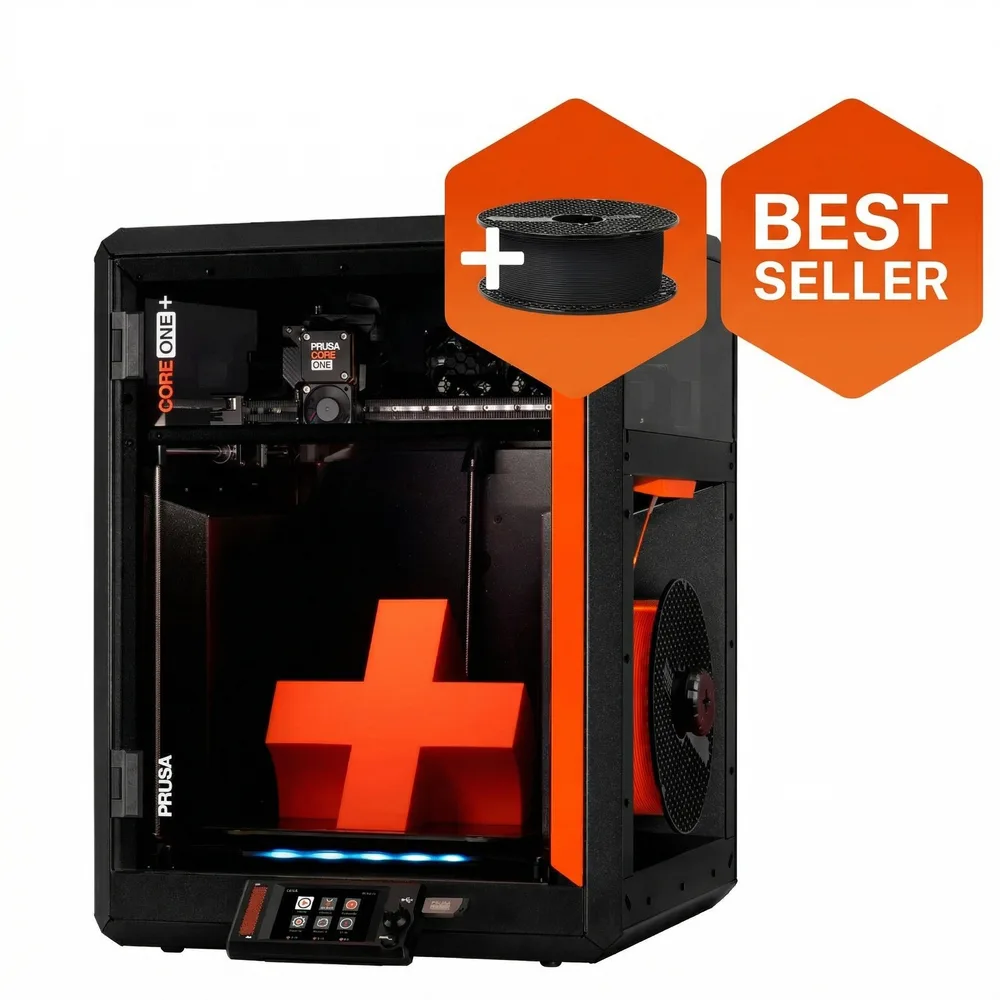
Product image from the manufacturer or its official distributor, reproduced to identify the model (legal notice).
CORE One+
The Prusa Research CORE One+ is a FDM 3D printer released in 2026 by Prusa Research, with a build volume of 250×220×270 mm and MSRP of €1,349. Compatible with MMU3 (5 slots). Enclosed chamber. Active heated chamber. Claimed maximum speed: 600 mm/s.
Manufacturer's suggested retail price (MSRP). Not the store price — the actual price may vary.
Our take on the CORE One+
The CORE One+ is Prusa's current enclosed printer: CoreXY, an actively heated chamber, a 120 °C bed and a 290 °C nozzle, with a 250 × 220 × 270 mm build volume. It's for people who want to print engineering materials on a machine with open software, repairable parts and one of the largest communities in the field behind it.
Against the Bambu Lab X1 Carbon or the Creality K2 Plus, it doesn't win on claimed speed or volume but on philosophy: it's also sold as a kit to build yourself, it takes the 5-filament MMU3, and Prusa says its nozzles swap in seconds without tools. It replaces the original CORE One in the line-up.
Worth knowing: according to Prusa, the internal camera is optional, not standard. Multicolour is an add-on too (the MMU3), and its volume is more modest than enclosed rivals at a similar price. If what you want is hassle-free multicolour at the lowest cost, there are more direct options in multicolour 3D printers.
Written from its specs and the sources cited at the end of this page; we haven't tested it in person.
Technical specifications
| Technology | FDM |
|---|---|
| Build volume | 250×220×270 mm |
| Weight | 22.5 kg |
| Max speed | 600 mm/s |
| Max acceleration | — |
| Max nozzle temp | 290 °C |
| Nozzle material | brass |
| Drive | direct |
| Flow rate | — |
| Max bed temp | 120 °C |
| Bed material | PEI spring steel |
| Auto-leveling | automatic (load cell mesh) |
| Enclosed | Yes |
| Heated chamber | Yes |
| AMS compatible | Yes (MMU3 (5 slots)) |
| WiFi | Yes |
| Camera included | No |
| Official slicer | PrusaSlicer |
| OrcaSlicer support | — |
| Power | 240 W |
| Noise | — |
What materials can the CORE One+ print?
This comes from four facts on its spec sheet: the nozzle reaches 290 °C, the bed 120 °C, and the machine is enclosed with a direct-drive extruder. Those four facts decide most of the list: nozzle temperature sets the ceiling on what you can melt, the bed decides whether the first layer sticks, the enclosure keeps large parts from warping, and the extruder type rules flexibles. We don't test the machine — this is guidance derived from verified data, not a guarantee.
In short: it prints PLA, PETG, TPU (flexible), ABS, ASA, Nylon (PA), Policarbonato (PC) without a fight.
| Material | Prints it? | Why |
|---|---|---|
| PLA | Yes | Yes. PLA has no special needs: any FDM printer like the CORE One+ prints it out of the box. |
| PETG | Yes | Yes. With a nozzle up to 290 °C and a bed up to 120 °C it comfortably meets PETG's needs. |
| TPU (flexible) | Yes | Yes. It has a direct-drive extruder, ideal for flexibles; prints TPU well (go slow). |
| ABS | Yes | Yes. Nozzle up to 290 °C and an enclosure: it contains ABS's warping and fumes. |
| ASA | Yes | Yes. Nozzle up to 290 °C and an enclosure: it contains ASA's warping and fumes. |
| Nylon (PA) | Yes | Yes. It reaches 290 °C and is enclosed: it prints Nylon (dry it well first). For carbon-fibre variants, use a hardened-steel nozzle. |
| Policarbonato (PC) | Yes | Yes. Nozzle up to 290 °C and an enclosure with active heating: suitable for PC. For carbon-fibre variants, use a hardened-steel nozzle. |
Popular comparisons
Own the CORE One+? Write a review
User opinions, moderated before publishing. hotend doesn't verify purchases.
Sources & references
Specs cross-checked against these public sources:
- Prusa CORE One+ official assembled product pagemanufacturer
- Prusa CORE One+ landing pagemanufacturer
- Prusa CORE One+ kit product pagemanufacturer
- Prusa KB — Input Shaper (acelerómetro integrado u opcional según modelo)Manufacturer pageretrieved10/7/2026
Specs checked against the sources cited above on 19/06/2026. Confidence in the data: high.